This image was selected as a picture of the week on the Farsi Wikipedia for the 13th week, 2011. (Photo credit: Wikipedia)I've been pondering this question this morning: What is a Qualitative Research Project?
I think the question may have been provoked by a sub-conscious question that I have been holding in my head for some time now, which is, Is the Journal Project over? Bringing this to the surface...brought me to: What is a Qualitative Research Project? and a host of other questions, such as...
What do Qualitative Research Projects contain?
How are they similar or different?
What are the visible, as well as the invisible, products of a project?
How is the data base counted as a product?
How do you conclude a project?
As invariably happens when I start asking myself questions...I find myself sketching out my ideas in some visual form...and then searching for ways to compare one example to another.
I ended up comparing three projects that I have been engage in over the last several years:
1. The Journal Project
2. Qualitative Research and Technology Project
3. The Sexting Project
In comparing them I realized that #1 and #3 both required the development of a classical QR data base of some sort. #2 was more focused on the research literature and the Internet--it was a study of methodology in transition.
None of "the projects" were discrete in terms of their construction/contents/or relationship to each other. They all bled across each other, and yet they were extremely distinct.
Looking at the contents of the different projects got me thinking about the lack of attention/recognition/acknowledgement we give to the data bases of qualitative research. They are recognized when peer reviewed publications emerge, but they are not shared nor made public. As a result they often languish in the background. I thought the emergence of qualitative research software would change this, but it hasn't. For the most part, while the construction of the data base may take vast amounts of effort, we don't credit ourselves for that work--we only get credit for publications.
Sketching things out and comparing products across projects, made me realize that different products emerge from different projects, and that many good products that come out of projects are not all that visible in the standard vita. Vita are linear and organized by product, not project. Yet, I find that I am organizing my life and my work by project. Good readers of vita follow the ebb and flow of projects within the description of products fairly well. However, given the ratings of different categories of products, they "see" some pages more clearly than others.
Here's an example...Journal Project, outputs are
DataBase
Articles
Presentations
Blog Entries
Art Exhibitions
Integration of autoethnography and arts-based research in courses taught
Appointment as Associate at the Center for Women and Work
Here's the QR and Technologies Project
Co-Authored Book
Presentations
Articles
Webinar
Judge of an Award
Blog Entries
Integration of QDAS in various forms of Coursework
Facilitation of Qualitative Research Network on Campus and Supervision of Campus-wide NVivo License
Chaired numerous dissertations that explored use of NVivo
Each project has completely different timeline and personnel configurations. The Sexting Project is huge compared to the Journal Project, and it is externally funded. For the Sexting Project there are many researchers, they combine in different ways to create products. But in this project, like the Journal Project, the creation of an original data base was an essential component. This is not to say that a methodology project like the QR and technology project doesn't have a data base--I actually don't know yet how to express that difference in clear terms.
So my final conclusion is that as qualitative researchers we need to do two things:
1. Start to acknowledge the creation of an original data base as a highly significant contribution on the order of writing many peer-reviewed journal articles (and recognize the responsibility this shift entails--sharing our data bases and making that available for review).
2. Insist upon being viewed for our whole(s)--the projects--that center our professional work. Let us find ways to make projects and their multiple products visible at the level of professional review (tenure/promotion/job selection).
I am sitting in Illini B--my gallery space for today and tomorrow. It's interesting to be quiet and just look at the things as they have been arranged on the dividers.
A few people have wandered in...not sure they were looking for me, but they stopped to look. A couple of people have stopped to fill out the prayer slips.
I am going to be giving my "gallery talk" at 3:30--that's coming up in 15 minutes. I am not sure I will have an audience, but I am here.
For the most recent newsletter of the Center for Women and Work, I was asked to write about the role of creativity in my life as an academic--how does creativity serve me personally and professionally. Here is that statement.
My creative endeavors lie in the arena of fiber and mixed media.From childhood on, I have been interested in fiber in all its forms – weaving, basketry, sewing, knitting, crocheting.Several years ago, I discovered felt—one of the most ancient of human fiber forms-- and in doing so found a home base for my creative activities.Felt draws on all my knowledge of fibers and their unique characteristics.The process of felting is akin to paper making and ceramics, and felt itself can be marked upon like cloth or paper.The possibilities seem endless to me.
Bringing this artistic interest in closer alignment with my ‘real job’—as a reading specialist, literacy researcher, and now qualitative research methodologist—has been a project of many decades.Only in the last few years have I been able to formalize the relationship between the hands-on maker and the thinker/writer through the development of ‘The Journal Project’, a study of an 18 month period of my personal journals that blends qualitative research software, arts activities, and autoethnography.This project central to my work as a Faculty Associate at the Center for Women and Work.
Fiber work connects me to the deepest places in my soul.It allows me to make tangible the issues of meaning making that are at the heart of qualitative research.The characteristics of fiber—color, texture, twist, feltability—become tools for expression.Fiber allows me to honor the process of inquiry, playfulness, spirituality, and the value of making.With the culmination of ‘The Journal Project’, I am creating an art exhibit that presents felt in the context of discussions of qualitative research methodology, allowing these two powerful sources in my life to join forces.
River: A piece that will be shown at the International Congress on Qualitative Inquiry: May 2011
Qualitative research is a social science approach grounded in unstructured, non-numerical methods.A hybrid of anthropological and sociological approaches, it has gained increasing acceptance in the 20th and 21st centuries.In the last quarter of the 20th century, qualitative research has been the site of two competing strands of interest: 1) a humanistic approach nourished by interests in the arts and literature; and 2) a focus on qualitative computing tools.These two approaches have, for the most part, continued on parallel but separate tracks into the 21st century.
As a qualitative researcher with interest in both strands, I have been hard put to find a way to integrate the two, causing serious tension for me as a researcher.It was this tension that led me to develop “The Journal Project” in which I undertook a qualitative research study that would build a bridge between autoethnographic and arts-based approaches and qualitative computing tools.The Journal Project was a study of 18-months of my personal journals during the years of 2006-2008.My goal was to examine these materials making full use of qualitative computing tools and arts-based methods of reflection.I wanted to show how arts and computing can play a role in every stage of the interpretive process.
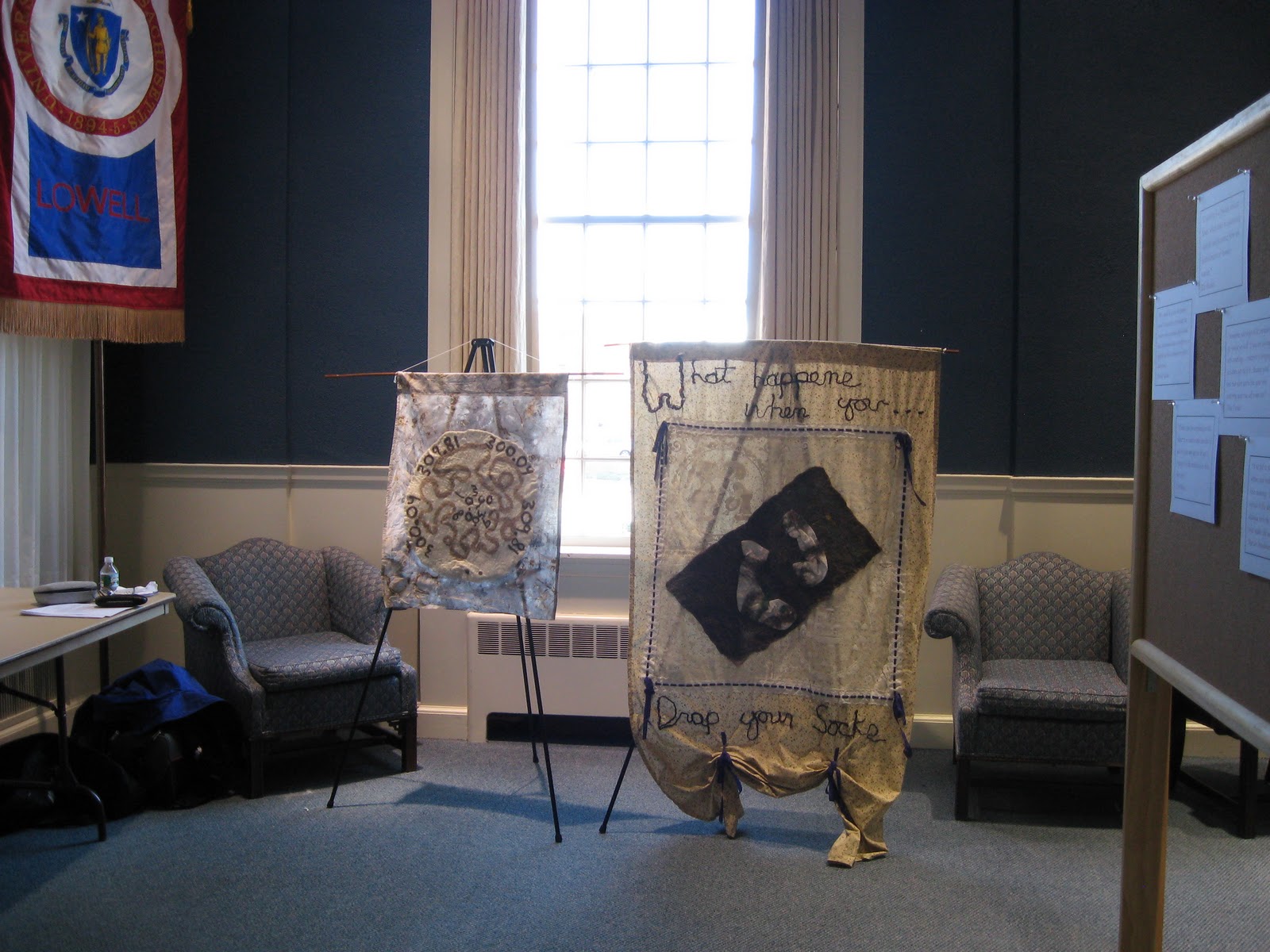
In this small exhibit I focus on two of the art works that have emerged in response to the Journal Project:“My Diagnoses” and “What Happens When You Drop Your Socks”.
Interior Conversations:Technology, Art, and Qualitative Research is the tentative title of the book that is emerging from this study.
My Diagnoses:(Upper Left Hand)
My diagnoses is a mandala shaped felt crafted from three natural colors of Navaho churro, a primitive sheep brought to the Americas by the early Spanish.I like its historical ties and its rough quality.On a white background, I needle-felted the numbers of my diagnoses in dark brown churro:
300.04:Dysthymic Disorder—a medium level depression lasting a minimum of two-years or more.
309.81:Post-traumatic stress/chronic.
These numbers are jumbled in the center…and sorted out around the rim.In between winds a circuitous path of light brown churro that works its way from inside to outside.
Interior Conversations probes the lived experiences of these diagnoses over the period of 2006-2008.
The felted piece is displayed against a piece of cotton hand-dyed with bits of old metal using India Flint’s eco-colour method.I am interested in the tension between felt, the most primitive of textile methods, with woven, manufactured cloth.
What Happens When You Drop Your Socks (Far right)
During the period of the journal study, I married my husband Bob,.As this screen shot from the NVivo E-Project demonstrates, there is significant material devoted to discussion of Bob in my many journal entries.
In contemplating what would best symbolize the good and the bad of the experience of intimacy referred to in 118 entries I was reminded of Bob’s habit of dropping his socks by the side of the bed.This led to the creation of a piece of felt in which Bob’s socks are embedded as if they were growing out of the dark wood of the floor by his bed.The felt is displayed on a background of homey lace figures, which are themselves displayed against a beige floral background.The words “What Happens When You Drop Your Socks” are written in handcarded, hand-dyed, hand spun yarns that I created.I liked the whimsy of the handspun that formed the cursive letters.Again, I am exploring the tension between the primitiveness of felt and the machine-perfect quality of today’s woven cottons.
In contemplating what would best symbolize the good and the bad of the experience of intimacy referred to in 118 entries I was reminded of Bob’s habit of dropping his socks by the side of the bed.This led to the creation of a piece of felt in which Bob’s socks are embedded as if they were growing out of the dark wood of the floor by his bed.The felt is displayed on a background of homey lace figures, which are themselves displayed against a beige floral background.The words “What Happens When You Drop Your Socks” are written in handcarded, hand-dyed, hand spun yarns that I created.I liked the whimsy of the handspun that formed the cursive letters.Again, I am exploring the tension between the primitiveness of felt and the machine-perfect quality of today’s woven cottons.
April 7, 2011
One of the most inspiring days I've spent on campus. A group of about 40 gathered at the UML Alumni Hall for a morning of intense thought about "Women as Makers: Creativity at Home, and in the Community".
The speakers were fantastic. We started with a panel "Crafting Our Lives Together"
Diana Coluntino, Artistic Director of the Revolving Museum, started us out. She showed her work as a hat maker--forms, methods, materials, styles--and talked about the work of the Revolving Museum. In their new space, they can serve many audiences. The Revolving Museum has done much to build community in Lowell for adults and young people. (Here is Karen working at her crocheting--a later task in the day.)
Karen Akunowicz, Culinary Program Manager/Chef of Fresh Roots at UTEC was the second speaker. I haven't had the chance to try out their wares--but I've heard many people talk about this program. I didn't realize that UTEC students farm an acre at Richardson's Farm and are also involved in the Farmer's Market here in town. Karen spoke to the ways cooking is a creative force in her life, her experiences learning the craft in Italy, and the transition from high end restaurant chef to working with youth who have encountered multiple challenges.
The third panelist was Betty Burkes, Curriculum Coordinator, of "Kids Rethink New Orleans Schools". Betty, a founder of a Montessori School on Cape Code, former leader and board member of Women's International League for Peace and Freedom, and a UN consultant on peace education--shared with us her history of learning about making peace in different local and international contexts, the most recent of which is New Orleans. At the conclusion she led us in few verses of "This Little Light of Mine".
To practice making, Sarah Kuhn, program organizer, led us in learning how to crochet hyperbolic planes. I learned that I could teach crochet...and I came up with a way of describing how you hold the yarn to sustain tension. [Sarah is on the left, trying to teach crochet via the large screen.]
The piece de la resistence of the day was the presentation by Mary Catherine Bateson...she spoke to her earlier work "Composing a Life" and the newest work (which I purchased and had signed)..."Composing a Further Life: The Age of Active Wisdom". I was intrigued by the way she connected her metaphor of "composing" to the earlier notions of the women's movement...and now to her later work and concerns with longevity.
The program was brought together by Sarah Kuhn, now of the Psychology Department at UML. Throughout the program a powerpoint loop of the crocheted coral reef that has been on display at the Smithsonian played on a large screen. Sarah took the pictures, and they were a great backdrop to the ideas of the day. It was a brilliant choice! Sarah is a leader in "Thinking With Things". She founded our campus IDEA group on this topic...she is also the founder of our Interdisciplinary Lab (another place to think with things). In this event she was definitely leading with her strengths.
We finished the day with a special small tour of the Interdisciplinary Lab. Several of the invited guests got to explore the lego collections. (Mary Catherine Bateson, Betty Burke, and Julie Bernson--Education Director of the Addison Gallery).
What was particularly exciting for me was that I was invited to share some of my felt pieces as part of an exhibit of the creative work of women on campus. I will post the "paper" in the next blog entry.
Meg Bond, Director of the Center for Women and Work and her great staff--were around, behind, involved in all the pieces and getting things to go smoothly.
I have been an Associate at the Center for Women and Work for the last two years and this event was yet another reminder of how valuable the center is to me and others on campus. It was so great to have a day of intellectual play like this. I am renewed. Thanks everyone.
My summer reading continues. I just finished Heewon Chang's book: Autoethnography as Method (Left Coast Press, 2008). It's a wonderful contribution to the literature on qualitative research methodology. With all of the hoopla about autoethnography over the last decade (and I don't mean that as critical) it was about time for a text like this to be written. Thank you Dr. Chang for doing so!
Heewon Chang has taken on the task of translating emergent ideas into concrete methods for the next generation of researchers (or for those in the field who haven't yet investigated these methods). Her writing is clear, well structured, and easy to follow. The contents of the book are informative and provide good grounding in the background that has been developing in this area. Examples and exercises are included that help to make the methods concrete for new learners.
I was particularly appreciative of her Part I: Conceptual Framework which provides solid definitions of the topics she will be discussing, and a discussion of the context in which her work is situated vis-a-vis various literatures. Her list of all the possibilities for terms for this kind of work was astounding. No wonder it can seem a daunting area to enter!
It gave me good things to think about in regard to my Journal Project, which I am still trying to locate within this literature. Interestingly, like any book that lays down the law (so to speak), it provides you with a backdrop for thinking about pushing the new boundary. Personally, I am wondering about the boundary between me and them/self and other. This will be my challenge, how to position something that is personal but professional within a discipline that is professional, with some hints of personal.
Saturday, January 23, 2010
Discernment and The Journal Project
I wrote in an earlier blog on discernment…from the top of my head, but knowing that someplace on my computer I had stored “the real” memo on discernment. I found it, of course, right where I put it—in the NVivo container of the Journal Project. (Described in an earlier blog). So here is some of that earlier, and I have to say, richer thought about the notion of discernment.
Looked at Oxford English Dictionary definitions; discernment is a word that emerged around 1500
It collected meanings from the Ignatious tradition, and from the Protestant tradition
(Amish, Congregationalists, Quakers).
What does it mean to discern?
-to find a life's path?
-to hear the call of your soul?
-to hear God speaking to you?
-to join in a community to make sense of direction for a group
-to be able to achieve clarity, make distinctions, see
Discernment can be imagined metaphorically
-trying to find a pathway in a forest
-seeking to see the way forward in a fog
-trying to come to an answer in a judicial inquiry in which each plantiff has a different view of the event
-a congregation struggling with the pivotal issues of an era (shall we oppose slavery? do we support the rights of gay, lesbian, and transgendered individuals?)
-an individual struggling with a private gnawing need, looking for resolution about life's dilemma's
In each of these examples, individuals or groups must find a way where the way is not clear. Discernment implies a systematic and probably wearying interpretive process in which information is gathered, sorted, sifted, reviewed, reshaped, and eventually used to recreate an understanding of events, beliefs, future direction, meanings, and possibilities.
What is the signficance of taking up this question as the focus of my Journal project—a study of two-years of my personal journals, 2006-2008? (see earlier blogs on this topic).
Is this simply a memoir?
It is a memoir, and it is document analysis undertaken from a qualitative research perspective.
It is a self-study and it is an exploration of qualitative data analysis software applied to humanistic directions in qualitative research?
I am insider on this study: I wrote the materials. I lived this life.
And I am outsider in this study: I have distanced the materials through commiting them to written journals, then redistancing them by re-entering them into NVivo and analyzing them there. Now instead of following the chronology, I find myself working within various categories of meaning that span the time; obcession, my family of origin. All of which has brought me close again to the moments and time in which I wrote.
I have a special challenge in serving as both writer of the journals and qualitative researcher. I have pledged myself to stay focused on the materials in the context of the two years that they represent. Many things have changed since then, and I look at my feelings and struggles from a different perspective today, but I have to try and screen that out...or make account of it because my emphasis is on grasping the emic perspective of me in that two year period.
I am examining my process of discernment...and that itself is an act of discernment. Me at one time and place; me at another--trying to understand how I moved myself forward to the next place in life.
The central question to this discernment is: As a middle aged female academic immediately post-tenure...is life finished or beginning? Are life's issues resolved? How does tenure affect the post-menopausal?
Why is discernment such a crucial issue to an academic? We are people who are supposedly responsible for our own paths, and yet we come to this place of so-called independence after years of careful socialization where all rough edges are chipped away. The socialization of being accepted in a graduate school, of serving under mentors, of attending conferences and hoping to catch the eye of the stars of our world, of mind numbing interviews in small towns across the country (places where those darn land grant schools were located), of servitude in the position of assistant professor--smiling and hoping we don't make any blunders, worrying about angry students and grading, and updating the vita over and over and over again--a set of white papers that seem to contain all of our life...that may seem more real than we are.
We are heavily socialized to be this thing and the socialization process is grueling and long and yet we are also supposed to be doing this to be independent thinkers—intellectual kings and queens who have the skills and knowledge to shape their own directions. Discernment then is core to our work. To discern who we are and what we believe is what the work of an academic is. To say anything about anything, we have to have struggled our way through an investigative journey of some kind to a new meaning. But the discernment of our professional work is not separate from the discernment that is further from public view, the discernment of our personal life.
How does the life that sustains us--the living, eating, breathing, loving, caring, hurting, sleeping--how does this figure into the discernment process of an academic? Do these things exist separately from the brain that tries to work out social theory, critique a dissertation, or write a journal article?
As a woman, how do the challenges of menopause, of realizing the end of childbearing years, of mourning the children one didn't have, of coming to grips with the childhood that shaped ones views of female self--how do these figure in the trials of academic life, where academic children come and go, where the elements of family can be seen enacting new dramas on the academic stage? How is shaping a female self in this workplace, a part of shaping one's female self in all dimensions of one's life?
How does the new creation of family, the acquisition of husband, step-children, in-laws, and the grandchildren that come along--how do these figure in the notion of female academic? How does the presence of step-daughter and daughter-in-law create new possibilities for understanding my aging self, my gifts and losses, and the work that I engage in as an academic?
What is at the heart of my process of discernment at this period in my life? What is significant about the challenges I faced? What could happen to me if I failed? Where would I land?
What are the paths or grooves that were created by the past? How do these shape my abilities to see the problems, find solutions, and move forward? Deeply grooved. Like the wagon ruts from the Oregon Trail that still exist 100+ years later, marks in the landscape that remind one of the Wagons lurching along with their battered cargos. This is like the self that tries to move forward, carrying a few belongings.
Anyone who has ever worked in an office knows that the personal and the professional are hopelessly intertangled. Much as we talk about "I am a professional" or "I can't believe that--it was so unprofessional" or "The professional thing to do would be to..." as if this realm were vastly separate and that we all understood it as the same thing...knows that the so-called personal is constantly invading our professional realm. Just as in marriages and families, our models--family and ancestors that went before--walk like ghosts in the halls of academia. The dead mother is with us at the table of a dissertation defense; the critical father makes himself heard in an angry rejoinder in a faculty meeting; a beloved sybling can be refound in a trusted colleague. Just as at home, they are there walking among us, shaping the ways we work with students, answer memos, and respond to Deans.
A part of discernment then must be coming to understand the ghosts, calling them forward, speaking with them and then sending them back to their world. This work reminds me of the Japanese O'Bon festival, where once a year the ghosts come back to our world. They are welcomed, celebrated, and then sent back with dancing and bonfires. I have memories of the dancers winding their way through the streets of Kyoto, and the fires lighting the mountain of Daimonji, which loomed above my room in the North of Kyoto near Kyoto University.
In the Catholic tradition, discernment evolved as a task of the individual--to separate good voices from bad, to sort out the devil's promptings from the voice of god.
In the Protestant tradition, discernment evolved as a task of the community--to listen for and to identify the true voice of god as it is speaking to the covenanted community.
As an academic woman, I am positioned (often uncomfortably) between the two, I must listen for the voice that will be my individual voice of scholarship--the muse that I will follow and need to be true to. I must also listen from within my community, as a scholar who participates in a community of scholars, we are committed to listening for the true voice, the path of our discipline. We are like a covenanted community, meeting through journals, conferences, and academic departments--we must try to separate the chaff from the wheat--in the ideas that come our way. This, too, is a kind of discernment. Like the early Protestant communities (Congregationalist, Quaker, or Amish) that took up this challenge, communities of scholars are by their nature engaged in ongoing struggles of change--conservatism vs liberalism--
Discerning discernment through the lens of one's own journals requires a good dose of humor and a recognition of the exceedingly self-centered nature of journals. These are the least objective of documents, and yet that is a part of their value. These particular journals were not written to be shared. They were written to note pain, absorb hurt, celebrate a personal joy, and to provide a means of interpretation--writing is thinking, as thinking is writing.
As I thought about discernment, I tried to get at the intricacies of this notion.
How is the nature of my process of discernment represented in the two years of journal entries?
What shape does it take?
What seems characteristic of it?
What are the elements that I combine within this process?
How is it balanced between personal and professional?
How is family--family of origin--developing a family of my own; a central theme in discernment?
What is the movement of discernment?
Does it have familiar paths? repetitions?
Are there techniques or tools that are uniquely mine? Which ones do I discover and make my own along the way?
What kind of growth do I achieve in my ability to discerrn?
What are the major events in these two years that my discernment processes must address?
How does my condition--female, middle-aged, academic, barely tenured--affect the ways that discernment unfolds in my life?
 This image was selected as a picture of the week on the Farsi Wikipedia for the 13th week, 2011. (Photo credit: Wikipedia)I've been pondering this question this morning: What is a Qualitative Research Project?